On finally turning the poems into songs, and the terrifying joy of letting them go
I have been writing my whole life. Mostly poetry. There are notebooks full of it, notes apps full of it, and at least one wall in at least one house I’ve lived in with it literally painted on. Words have always been the way I make sense of things, the way I take whatever is rattling around inside me and give it a shape I can hold. But if I’m being honest, there has always been a quieter wish sitting underneath all that poetry, one I didn’t say out loud very often because it felt a little too big, a little too much like something other people get to do. I wanted to write songs. Not just words on a page that someone reads silently and moves past, but words with a heartbeat under them. Words you could turn up in the car.
That wish didn’t come out of nowhere. It came from my dad. My dad was a musician, a real one. In the 70s, his band opened for REO Speedwagon, which is a sentence I have said out loud at parties more times than I can count, because come on. That’s cool. That will always be cool. But beyond the bragging rights, growing up as his daughter meant I always knew music was something people could make. Not just something that came out of the radio, finished and untouchable, but something a real person sat down and built out of nothing but feeling and nerve. I’ll never forget watching my dad play every week at church, or the jam sessions with his old band that he’d let me tag along to. I was the kid in the corner soaking up every note, not knowing yet that I was taking notes.
In the 70s, his band opened for REO Speedwagon, which is a sentence I have said out loud at parties more times than I can count, because come on. That’s cool. That will always be cool.
Then, when I was in my early twenties, he wrote a song for me. It’s called “My Little Girl.” (You can find it everywhere music is streamed, including on Apple Music here.) I still don’t know how to fully explain what it does to you to be the subject of your father’s song. It’s a strange, holy kind of feeling, like being seen and held at the same time in a language you don’t speak but somehow understand completely. His song was about watching me grow up. About the little girl becoming a woman and him standing there, proud and a little heartbroken, watching it happen. So when I finally sat down to write a song of my own, the first one I wrote was a response to him. Of course it was. Where else would I start? His song was about me growing up. Mine is about the fact that no matter what, no matter how old I get, I am still his little girl. It felt like finally answering a letter I’d been holding for nearly two decades.
Here’s what nobody tells you about wanting to write music: the words were never my problem. I had lyrics for days. I could hear the melody in my head, clear as anything, down to where the voice should break and where it should soar. The hard part was that I don’t play a single instrument. Not guitar. Not piano. Not even a respectable tambourine. So every song I heard in my head stayed exactly there, trapped, with no way out. I had the blueprint and no hands to build the house. For years, that felt like a locked door, and I’d sit in front of it and knock every so often just to feel the ache of it. I’d write the words, hum the tune in the car, and then fold it up and put it away, because what was I supposed to do with it? Hire a band? Learn guitar at this stage of my life, with my schedule? Bitch, please. And there’s a particular kind of grief in that, carrying something you know is good and having nowhere to set it down. So I carried it. Every lyric, every melody, every emotion, every hope, tucked deep inside me for three decades. Waiting.
Then I discovered Suno, an AI music tool, and I started playing with it. Just playing, at first. Curious. Honestly, a little skeptical. I know how people feel about AI and art. My own daughter says AI art isn’t art, just a cheap imitation, and I understand where that comes from. But every new tool was “cheating” once. Somebody clutched their pearls over the electric guitar, too, and somebody else swore drum machines would be the death of real music. I’ve decided to let people have whatever opinion they want about AI-empowered art and music, and I’ve also decided I don’t have to carry those opinions around with me. If you have negative things to say, keep them to your damn self. Because the first time I heard one of my own songs come back to me with a sound wrapped around it, I sat quietly in my living room chair and cried. It was mine. My words, my melody, my story, the thing I’d been carrying for thirty years, finally outside of my own head where I could hear it like anyone else would. The door I’d been sitting in front of for so long didn’t just crack open. It swung wide. Since then, I’ve written ten songs. Ten! Eight of them made the cut for a full album, which (I still can’t believe I’m typing this) releases next week.
Eight of them made the cut for a full album, which (I still can’t believe I’m typing this) releases next week.
Now, if you think using AI means you type a sentence and a finished song falls out of the sky, let me lovingly correct you. AI has its own ideas. It wants to make things pretty and polished and a little generic, and my job was to keep dragging it back to me. My voice, my sound, the melody I heard, the rhythm I wanted, the specific inflection on a specific word that makes the whole line land. Finding the sound meant listening to the same verse forty-seven times and knowing, deep in my gut, that it was almost right but not quite. The tempo was off. It was too polished. It was too sad. It wasn’t sad enough. The voice was beautiful, but it wasn’t MINE. It meant rewriting a line at midnight because it sounded perfect on paper and wrong out loud, and getting attached to a version only to realize at 1 a.m. that it had to go. The first track I released had at least fifty versions before it was RIGHT. Fifty. Tell me again how AI does all the work. And every one of those versions cost me something, because every time I said “no, that’s not it,” I had to go back in and feel the thing again to know what “it” was. I think that’s how you know it’s real. It hurts a little to get it right.
I think that’s how you know it’s real. It hurts a little to get it right.
Then came the part that actually scared me. Making the songs was vulnerable, but releasing them was a whole different level. Getting music onto streaming platforms means a hundred tiny decisions that feel enormous when it’s your heart on the line. Picking the cover art. Typing the song title into a form and just staring at it. Deciding what name goes on it. Clicking submit and then waiting for approval like I was waiting on test results. And the whole time, a little voice in the back of my head kept asking, who do you think you are? Imposter syndrome is real, and when you add AI to the mix it gets louder. I have worked so hard to make these songs as true and as authentic as I possibly can, and I’ve still lain awake wondering whether anyone will believe that. Whether people will hear the heart in them, or just hear the tool. But here’s what I keep coming back to: the tool didn’t live my life. I did. I’ve stood in front of rooms full of executives and asked for big deals without blinking. But uploading a song that says true things about my life? That made me want to hide under the covers with my phone on airplane mode.
So I did it quietly. As I write this, only my husband and my bestie know I’ve released a song. Today, with no fanfare at all, the first one went live. It literally exists now. It has its own identity, its own little space on the streaming apps, my name attached to it, and almost nobody knows it’s there. There’s something tender about that, like a secret I’ve been keeping for a few hours and am now telling you. I woke up this morning, scrolled through my email half awake, and stopped dead in my tracks. Congrats, your song is live! What a feeling. I read it about six times, just to be sure it was talking to me.
What a feeling.
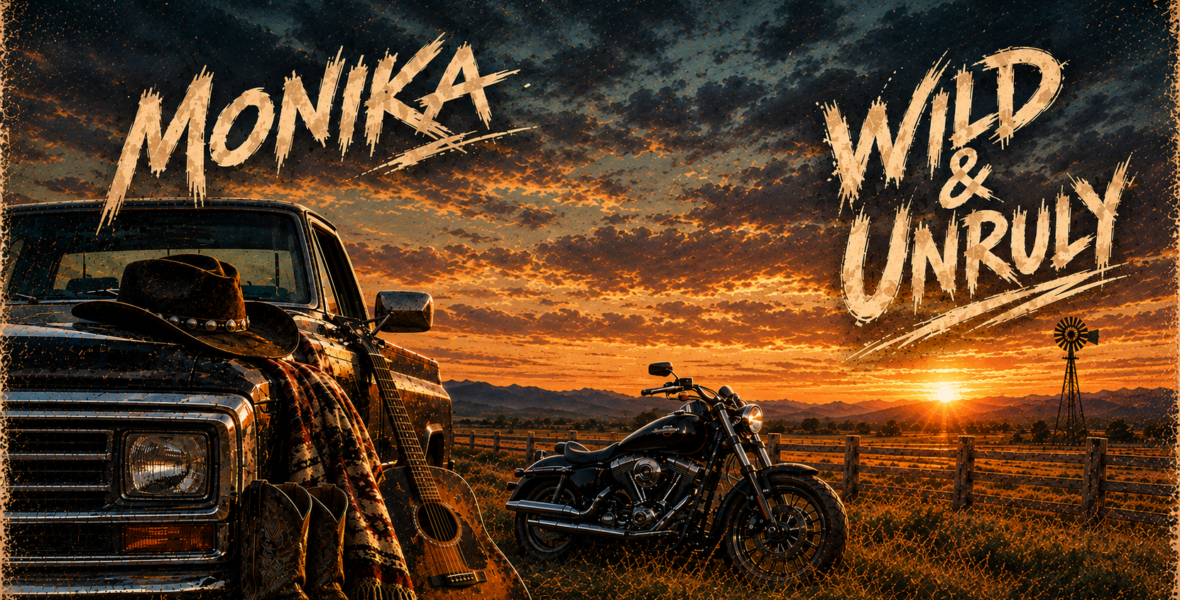
That song is Wildfire, the first song from the album, and it’s out now on all the streaming platforms. It’s about how I love. It was inspired by a poem I wrote ages ago titled “Wild & Unruly,” which also became the name of the album, and it’s the truest thing I know how to say about myself. I don’t love halfway. I never have. I’ve been called “too much.” I’ve been told I’m “smothering.” I’ve even been told that all my passion is what pushed people away. It took me a long time to stop apologizing for that, and even longer to start embracing it as one of my biggest strengths. Because here’s the thing about a wildfire: nobody asks it to be a candle. Wild and unruly? Guilty as charged. I chose Wildfire to go first because this song is my heart, the essence of who I am. If you only ever hear one song of mine, I want it to be this one, because this is the one that tells you who I am.
I also want to be really clear about something, because I know how this might look. I am not trying to become a pop star. You will not find me on a stage in sequins next summer (unless it’s karaoke and there’s a stiff drink involved, and even then, no promises). I’m not booking tours. I’m not chasing a record deal. I’m a writer. I’ve always been a writer, and these songs are just another form of the thing I’ve been doing my whole life. My goal is simple: I want the music out there, so people can hear it and maybe feel something. That’s it. That’s the dream. Okay, fine, one more little dream, since we’re being honest. If someday someone really famous hears one of these songs and wants to record it and make it their own? I would absolutely lose my mind in the best way. Call me. My number’s not listed, but I’ll find you.
Mostly, though, I’m just excited. Genuinely, giddily excited in a way I haven’t felt about anything creative in a very long time. That locked door I sat in front of for years is open. The songs that only ever lived in my head are finally out in the world, and on September 29th, all eight of them will be. My dad wrote me a song once. Now I’ve written a whole album. I think somewhere in all of this, I’m finally writing back.

Go listen to Wildfire
Then come back and tell me what you felt. And stay tuned, because Wild & Unruly drops September 29th, 2026.
Listen to Wildfire

